

Hot weather camping sounds lovely in theory.
Blue skies. Long days. Camp chairs in the shade. Maybe a lake. Maybe a cold drink. Maybe you, living your best outdoorsy life like a person in a catalog who has never once had thigh sweat.
And then nighttime comes.
Suddenly your tent is a nylon crockpot, your sleeping bag feels like a swamp, and you are lying there wondering if anyone has ever successfully slept while lightly marinating.
I love camping. Truly. Deeply. In a way that has led me to own far more lanterns than any one woman needs.
But hot, sticky tent sleep is where things can go sideways fast.
The good news is that you can make summer camping much more comfortable with a few smart choices. You do not always need an electric campsite, a portable air conditioner, or a dramatic personality change. Though the dramatic personality change may happen anyway around 3 a.m. if your tent has no airflow.
Here are 10 ways to stay cool when camping, especially at night.
1. Pick the shadiest campsite you can get
Shade is not just a nice little bonus. Shade is the whole ballgame.
A tent sitting in full sun all afternoon becomes a tiny fabric oven. And not the cozy kind that makes cinnamon rolls. The bad kind. The kind where you unzip the door and get hit with a blast of hot air that feels personal.
When you get to your campsite, look for trees, especially on the west side of where your tent will go. Afternoon sun is usually the hottest, so blocking that late-day heat matters.
If you have a choice between morning shade and afternoon shade, take the afternoon shade.
Morning sun may wake you up a little earlier, but afternoon sun will make your tent feel like it is trying to cook you.
2. Set up where the air actually moves
Before you pitch the tent, stand still for a minute.
I know. It feels ridiculous. You are holding tent poles. Someone is probably asking where the stakes are. A dog may be trying to eat a leaf.
Still, pause.
Can you feel a breeze? Is the air moving? Or does the site feel like a damp sock?
If your tent has two doors or big mesh windows, set it up so the breeze can move through it. Cross-breeze is your friend. Stale air is your enemy. Stale humid tent air is the villain of this story.
Avoid low spots where heat and damp air settle. A slightly more open site can feel much better at night.
3. Use a tent with lots of mesh
Some tents are great for cool weather. Some tents are great for rain. Some tents are great for looking adorable in photos and then turning into a sauna the second the sun touches them.
For hot weather, you want mesh.
Big mesh panels. Mesh doors. Mesh windows. Roof vents. Anything that lets air move.
If the weather is dry and bugs are the only issue, sleep with the rainfly off. This makes a huge difference. You get more airflow, less trapped heat, and maybe even a view of the stars.
Just keep the rainfly nearby in case the weather changes, because camping likes to humble us.
4. Open the tent before bedtime
Do not wait until you are ready to crawl into bed to cool down the tent.
By then, your tent has been sitting there all day collecting heat like it is preparing for a science fair.
As soon as the sun starts to drop, open the doors, windows, and vents. Let the hot air escape. If your tent has two doors, open both.
Keep the mesh zipped if bugs are out, unless you enjoy sleeping with mosquitoes and then pretending you are fine.
You are not fine. No one is fine.
5. Bring a battery-powered fan
A small fan can save a summer camping trip.
It does not need to be huge. It does not need to be fancy. It just needs to move enough air that you no longer feel like you are sleeping inside a plastic bag.
Look for a rechargeable fan or one that runs on batteries. I like fans with a hook or clip so you can hang them from the tent ceiling or attach them near your bed.
Bonus points if it has a light. Extra bonus points if it does not sound like a tiny lawn mower.
Place the fan near a mesh window or door if you can. That way it can help pull cooler air through the tent instead of just stirring the warm air around like soup.
6. Try a portable camping air conditioner if you have the power for it
This is the “I am done suffering” option.
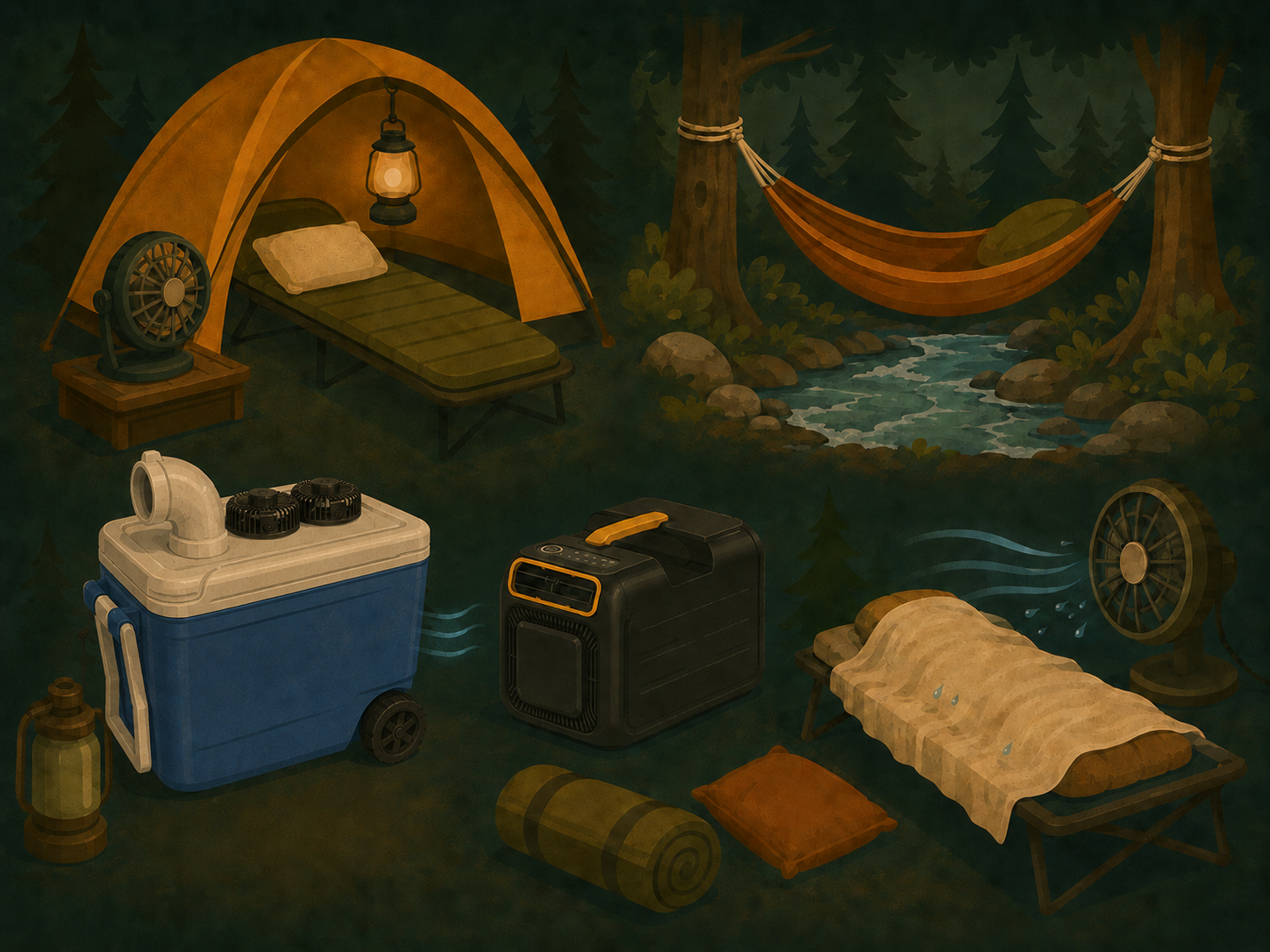
Portable camping air conditioners, like the BougeRV portable air conditioner, are made for small spaces like tents, vans, campers, and compact camping setups.
A real portable AC is different from a fan or an ice cooler setup. It uses a compressor and needs to vent hot air out, just like a household portable AC. That means you need to think through the whole setup before you rely on it at camp.
You will need:
A power station or electric campsite
A way to vent the hot exhaust outside the tent
A small enough tent or sleeping space for the AC to matter
A plan for condensation or drainage, depending on the unit
Realistic expectations
That last one matters. A portable camping AC is not going to turn a giant tent in full sun into a walk-in cooler. But in a small tent, rooftop tent, SUV camper, van, or compact canvas tent, it can make a hot night much more tolerable.
Would I bring one for every trip? No.
Would I consider one for a brutally hot summer campsite where sleep is otherwise not happening? Absolutely.
Just test it at home first. Plug it into your power station, run it for a while, figure out the exhaust hose, and see how long your battery actually lasts.
Nothing says “character building” like confidently setting up your air conditioner at camp and then watching your battery die at 11:42 p.m.

7. Build a simple DIY swamp cooler
A DIY swamp cooler is the scrappy cousin of a portable air conditioner.
It is not the same as real AC. It will not cool a sealed tent the way a compressor-based unit can. And in humid weather, it may not work as well because the air is already carrying a lot of moisture.
But as a personal cooling setup? It can help.
The basic idea is simple:
Fill a cooler with ice or frozen water bottles.
Set up a small battery-powered fan so it blows air into the cooler.
Add a vent, duct, or short hose so cooler air blows out toward your sleeping area.
Aim the cool air at your cot, bed, or chair.
Use frozen water bottles if you want less melted-ice chaos.
You can make a version with a small hard-sided cooler, a fan, and a short dryer vent or flexible duct. Some people cut a hole in the cooler lid for the fan and another hole for the vent.
A few important safety notes:
Do not use dry ice in an enclosed tent.
Do not let water spill near batteries, cords, or power stations.
Do not seal yourself into a tent with any device that needs ventilation.
Do not expect miracles in thick Midwestern humidity.
Humidity laughs at our plans. It was raised that way.
Still, if you already have a cooler, ice, and a fan, it is a fun low-cost experiment. At worst, you have a fan and cold drinks, which is not a bad fallback plan.
8. Use my grandmother’s wet sheet trick
This is old-school, a little weird, and surprisingly effective.
My grandmother used to soak a cotton sheet in cool water, wring it out really well, lay it over us, and aim a fan over it.
That is it. That is the technology.
And honestly? Grandma was onto something.
The trick is to use a thin cotton sheet, not a heavy blanket. Get it cool and damp, not dripping. Wring it out well, then lay it over you while a fan moves air across it.
The moving air helps with evaporation, and the damp sheet can cool you down enough to fall asleep.
This works best in dry or moderately humid weather. In heavy humidity, it may feel more like you are being tucked in by a swamp, so use judgment.
Also, protect your sleeping pad or bedding if needed. You want “cool and lightly damp,” not “why is all my gear wet?”
9. Sleep in a hammock

If your campsite allows it and you have good trees, a hammock can be one of the coolest ways to sleep in hot weather.
Unlike a tent bed, a hammock lets air move all around you. Under you, over you, around your sides. You are basically hanging in a tiny breeze cradle like a very relaxed woodland burrito.
And if you can safely hang near moving water? Even better.
I once hung a hammock over a spring-fed river in the Texas Hill Country in the middle of summer, and I actually got cold in the night.
Not “less sweaty.” Not “slightly more comfortable.”
Cold.
In Texas.
In summer.
Which feels like witchcraft, but it was really just moving air, cool water, and the magic of not sleeping inside a nylon heat bag.
A few hammock tips:
Use wide tree straps, not rope, so you do not damage the trees.
Make sure hammocks are allowed at your campsite.
Do not hang too high.
Do not hang over unsafe water, fast current, rocks, or anywhere a fall would be dangerous.
Bring a light blanket or sheet, because that cool air underneath you can sneak up fast.
Use bug netting if mosquitoes are out, because nature loves to humble us.
For really hot nights, a hammock can be cooler than a cot and much cooler than sleeping on the tent floor. Just know that once the temperature drops, you may need a light blanket, underquilt, or pad because all that airflow under you can go from “ahhh” to “why am I shivering?” faster than expected.
10. Rethink your whole sleep setup
A winter sleeping bag in July is a mistake you usually only make once.
Maybe twice, if you are stubborn.
For warm weather camping, bring lighter bedding. A sheet, a lightweight camp quilt, a muslin blanket, or even a thin fleece may be all you need.
You can still keep a sleeping bag nearby in case the temperature drops, but do not zip yourself into a mummy bag if the night is warm.
That is not camping. That is becoming a burrito with regrets.
A cot can also help because it lifts you off the tent floor and lets air move underneath. If you have room in your tent, a cot is a great summer option. Add a lighter sleeping pad on top if you need cushion, but skip the heavy insulated winter setup unless the forecast actually calls for it.
And please, change into dry sleep clothes.
Do not sleep in the clothes you sweated in all day.
Even if they feel mostly dry. Even if you think, “It’s fine.” Even if you are already in the tent and your clean clothes are in the car and the car is seven whole steps away.
Change.
Dry sleep clothes help your body cool down and make you feel less sticky. A loose cotton or moisture-wicking shirt and shorts can make a hot night much more tolerable.
This is also a good time to wipe down with a damp towel, splash your face, or use a body wipe if showers are not available.
It is not glamorous. But neither is waking up fused to your sleeping pad.
What to pack for hot weather camping
For warm camping trips, I like to have a few stay-cool basics on hand:
Battery-powered or rechargeable fan
Lightweight sleep clothes
Sheet or summer camp quilt
Cooling towel or bandana
Spray bottle
Bug spray
Extra water
Electrolytes
Shade tarp or canopy
Tent with good mesh and vents
Cot or breathable sleep setup
Optional extras:
Portable camping air conditioner
Power station
DIY swamp cooler setup
Cooler with ice or frozen water bottles
Cotton sheet for the wet sheet trick
Hammock with tree straps
Bug net for hammock camping
You do not need every single thing. Start with shade, airflow, light bedding, and a fan. Then decide how fancy you want to get.
The bottom line
Staying cool while camping is mostly about shade, airflow, and not bringing your cold-weather sleep system on a summer trip like an optimistic fool.
Pick a shady site. Open the tent early. Use the mesh. Bring a fan. Sleep in dry clothes. Trade the heavy sleeping bag for lighter layers.
If you want to get more serious, a portable camping air conditioner can help in small spaces if you have enough power and a way to vent the hot air. A DIY swamp cooler can be a fun low-tech experiment. A damp cotton sheet with a fan is the kind of grandmother-approved wisdom that deserves respect. And a hammock over cool moving water might be the closest thing to actual camping magic.
Because if you wake up at 2 a.m. sweaty, annoyed, and wondering if anyone has ever successfully slept in August, you are not alone.
We have all been there.
Some of us just brought better fans the next time.
Thank you for reading!
Stay wild and wander often.
~Alana


Leave a Reply