


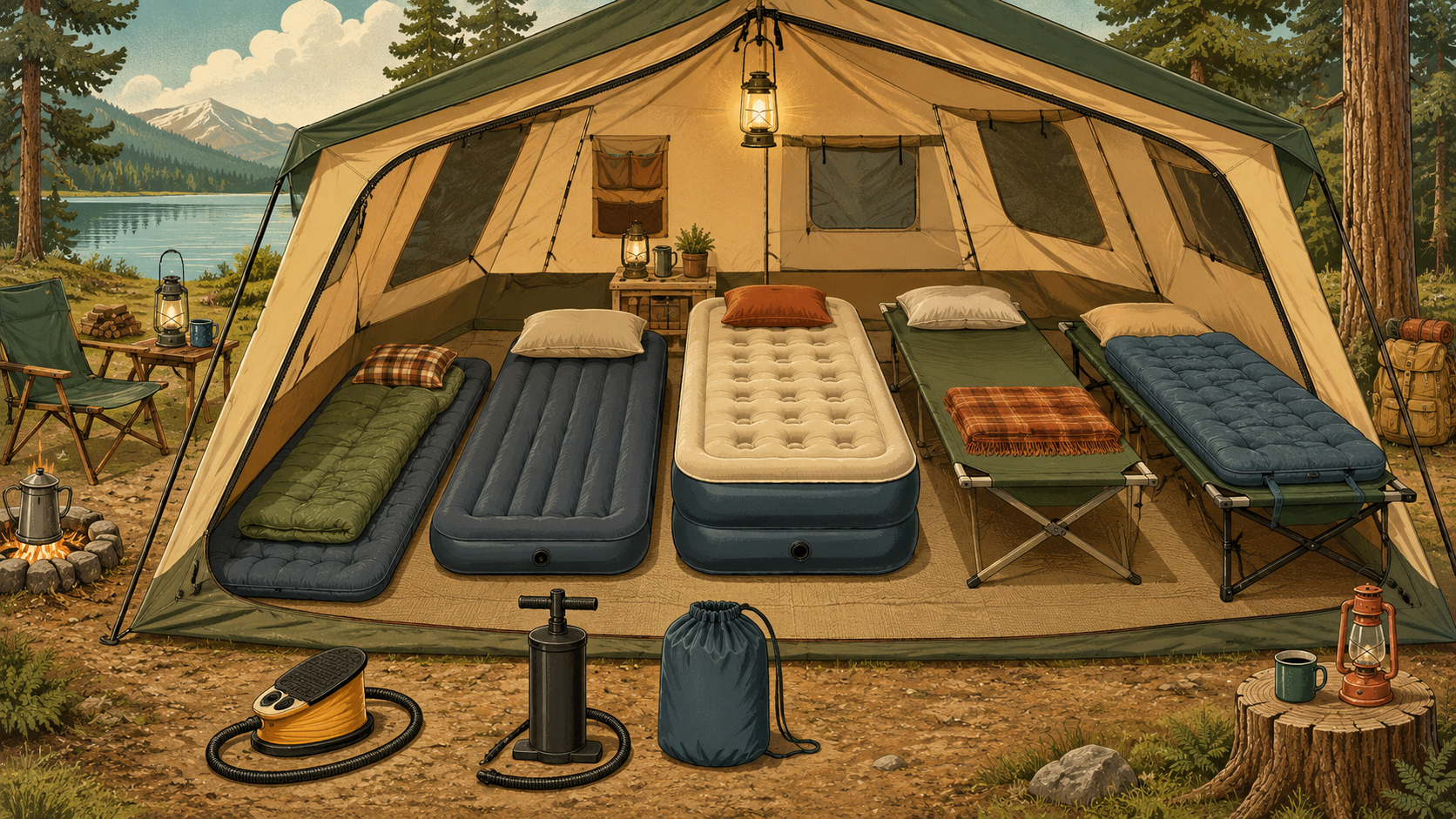
A reader asked:
“In search of a comfortable bed/cot for tent. If it requires air, how do I inflate it without power?”
This is such a good question because sleep can make or break a camping trip. You can have the prettiest campsite, the best campfire snacks, and a perfect view, but if you wake up sore, cold, or half-deflated on the tent floor, camping suddenly feels a lot less fun.
The good news is that you do not need an electric campsite to sleep well in a tent. You just need the right sleep setup and the right way to inflate it.
My short answer
If you are tent camping and want real comfort, skip the basic air mattress and get a thick self-inflating foam camp pad.
My personal pick is the UST Fillmatic.
Dave’s pick is the REI Camp Dreamer XL.

For Amazon alternatives, I would start by searching for Hikenture 4-inch self-inflating sleeping pad, LOSTHORIZON air and foam camping mattress, Elegear self-inflating sleeping pad, or KingCamp self-inflating camping pad. (I also own that last one and find it every bit as comfortable as the Fillmatic and Camp Dreamer.)
Choose the thickest rectangular foam-and-air pad that fits your tent and your budget. Your back will thank you in the morning.
My favorite tent camping sleep setup
For most casual tent campers, I recommend one of these two setups:
- A cot with a sleeping pad on top
- A thick self-inflating foam sleeping pad directly on the tent floor
If comfort is the main goal, a cot plus a pad is usually the winner. The cot gets you up off the ground, which makes getting in and out of bed easier. The pad adds cushion and insulation, so you are not sleeping on cold fabric stretched over a frame.
A cot by itself can feel firm. An air mattress by itself can feel bouncy, chilly, or unstable. But a cot with a good foam or self-inflating pad on top feels much more like a real bed.
Cot vs. air mattress vs. sleeping pad
Here is the simple breakdown.
| Sleep option | Best for | Things to know |
|---|---|---|
| Cot | Campers who want height and support | Can take up more room in the tent |
| Air mattress | People who want a bed-like feel | Can lose air, feel cold, or need a pump |
| Self-inflating pad | Comfort without much fuss | Usually lower to the ground |
| Foam sleeping pad | Simple, durable, no inflation needed | Less plush than other options |
| Cot plus pad | Best overall comfort | Bulkier, but great for car camping |
If you are car camping, weight is not a huge issue. That means you can choose comfort over compact packing. And honestly, that is the way to go.
What makes a camping bed comfortable?
When choosing a cot, mattress, or pad, look for these things:
1. Enough width
A narrow cot can feel like sleeping on a balance beam. If you toss, turn, or sleep on your side, look for a wider cot or a wider sleeping pad.
2. Good support
A soft air mattress may feel comfy at first, but if it does not support your hips and shoulders, you may wake up sore. A firmer sleeping surface with a soft layer on top is often better.
3. Insulation from the ground
This is the part people forget. The ground can pull heat from your body, even in mild weather. Air mattresses are especially bad about this because the air inside can get cold.
A foam pad or insulated sleeping pad helps a lot.
4. Fit inside your tent
Before buying a cot, check your tent floor size. Also check the wall angle. Some cots fit on paper but bump into sloped tent walls once they are set up.
If you are using a tall cot, make sure you still have enough headroom to sit up comfortably.
Do you need power to inflate an air mattress?
No, you do not need campsite power.
You have several easy options for inflating a camping mattress without plugging into an outlet.
How to inflate a camping mattress without power
Option 1: Use a rechargeable air pump
This is one of the easiest choices for car camping. Charge the pump at home before your trip, then use it at camp. Many small rechargeable pumps are made for air mattresses, pool floats, and sleeping pads.
Look for one that includes different nozzle sizes so it fits your mattress valve.
Best for: car camping, family camping, larger air mattresses
Option 2: Use a battery-operated pump
Some air pumps run on regular batteries. This is a nice backup because you do not have to remember to charge anything. Just pack fresh batteries and extras.
Best for: simple camping trips, backup inflation
Option 3: Use a foot pump or hand pump
This is the old-school option, and it still works. A foot pump or hand pump does not need electricity, batteries, or charging.
It takes more effort, but it is reliable.
Best for: campers who want a no-fail option
Option 4: Use a pump sack
Many backpacking and camping sleeping pads come with a pump sack. You trap air in the sack, attach it to the valve, and squeeze the air into the pad.
It looks a little strange the first time you do it, but it works well. It is also better than blowing into the pad with your mouth because it keeps moisture out of the inside of the mattress.
Best for: insulated sleeping pads, backpacking-style pads, compact camping setups
Option 5: Use a 12V car pump
Some pumps plug into your vehicle’s 12V outlet. This works well if you are camping near your car.
Just be mindful of your car battery. Inflate the mattress before bedtime, not after the car has been sitting unused for a long time. And never run a vehicle in an enclosed area.
Best for: big air mattresses and campsites close to your vehicle
Option 6: Choose a self-inflating pad
A self-inflating pad has open-cell foam inside. When you open the valve, the foam expands and pulls in air. You may need to top it off with a few breaths or a pump sack, but it does most of the work on its own.
This is one of my favorite options for tent camping because it gives you cushion, insulation, and easy setup without needing a big electric pump.
Best for: comfort with minimal fuss
Should you blow up a mattress with your mouth?
Only as a last resort.
For a basic pool-float-style air mattress, it is not the end of the world. But for insulated sleeping pads, it is better to avoid mouth inflation when possible. Your breath adds moisture inside the pad, which can lead to mildew over time and may reduce performance in cold weather.
A pump sack, small pump, or foot pump is a better choice.
What I would buy for a comfortable tent bed
For most beginner or casual campers, I would build the sleep setup like this:
Best comfort setup:
A sturdy cot plus a 2 to 4 inch self-inflating sleeping pad
Best simple setup:
A thick self-inflating foam pad on the tent floor
Best budget setup:
A basic cot with a foam camping pad on top
Best no-inflation setup:
A cot with a folding foam mattress or closed-cell foam pad
Best for couples:
Two separate sleeping pads instead of one big air mattress
That last one matters. A big shared air mattress can feel cozy in theory, but every time one person moves, the other person bounces. Two separate pads usually mean better sleep.
A few extra tips for better sleep in a tent
Bring a real pillow from home if you have room. Camp pillows are compact, but a regular pillow is often much more comfortable.
Add a blanket under your sleeping bag or quilt if the night will be chilly. That extra layer helps block cold coming up from below.
Test your bed setup at home before your trip. Inflate it, lay on it, and make sure the valve works with your pump.
Pack a small repair kit if you use anything inflatable. A tiny leak can ruin a night of sleep.
And if you are using a cot, put a small rug, mat, or folded blanket under the cot feet if you are worried about wear on the tent floor.
The bottom line
The most comfortable tent camping bed is usually not just one thing. It is a layered setup.
A cot gives you height and support. A sleeping pad gives you cushion and warmth. And a simple battery pump, rechargeable pump, foot pump, or pump sack means you do not need power at your campsite.
So yes, you can absolutely have a comfortable bed in a tent without an electric hookup.
And once you sleep well outside, camping gets a whole lot easier to love.
What we personally use
In our own tent camping setup, we are firmly in the self-inflating camp pad camp.
I personally use the UST Fillmatic sleeping mat, and I love it. It is a foam-and-air style mat, so it gives you more cushion than a thin backpacking pad, but it does not feel as wobbly as a regular air mattress. UST lists the regular Fillmatic at 72 x 25 x 4 inches, and the XL version at 80 x 30 x 4 inches, so it has that thick, bed-like feel that makes a huge difference when you are sleeping in a tent.
My husband Dave uses the REI Co-op Camp Dreamer XL Self-Inflating Deluxe Bed, which is also a really comfortable car camping pad. REI lists it as 78 x 30 x 4 inches, with an R-value of 6.6, which means it gives you good insulation from the ground along with the cushion.
Both of these are much closer to a “real bed” feel than a basic air mattress. They are not tiny backpacking pads. They are bigger, bulkier, and better suited for car camping. But if your goal is comfort, that tradeoff is worth it.
Similar sleeping pads to look for on Amazon
If you are shopping on Amazon, look for a self-inflating foam camping pad that is around 3 to 4 inches thick. That is the sweet spot for comfort in a tent.
A few similar styles to search for are:
Hikenture 4-Inch Self-Inflating Sleeping Pad
This is one of the closest Amazon-style options to the UST Fillmatic and REI Camp Dreamer idea. It is a foam-and-air pad, not just a thin inflatable backpacking mat. Some versions are listed with a 9.5 R-value, so it is meant to provide insulation as well as cushion. Available on Amazon
LOSTHORIZON Air & Foam Camping Mattress
This is another plush car camping option. It is a thicker foam-and-air style mattress, so it is better for people who want a softer, more bed-like feel. The brand lists some models with high insulation ratings, but check the exact Amazon listing before buying because sizes and R-values can vary by model. Available on Amazon
Elegear Self-Inflating Sleeping Pad
Elegear makes thicker foam camping pads that are often positioned as comfort-focused car camping mattresses. Some Amazon listings show versions around 3.15 inches thick with built-in pump features, which may be helpful if you do not want to pack a separate pump. Available on Amazon
KingCamp Self-Inflating Sleeping Pad
KingCamp is another reasonable search term if you want a more budget-friendly foam-and-air camp pad. I would look for a rectangular self-inflating version rather than an ultralight backpacking version if comfort is the priority. Available on Amazon

Clostnature Self-Inflating Camping Mat
Clostnature has budget self-inflating camping mats that may work well for occasional campers. These are usually more affordable, but I would check thickness carefully. A 1.5-inch pad will not feel anything like a 4-inch pad. Available on Amazon
Coleman Self-Inflating Camp Pad
Coleman’s self-inflating pads are usually more budget-friendly and easy to find. They are a good starter option, but they are often thinner than the UST Fillmatic or REI Camp Dreamer, so they may not feel as plush. Available on Amazon
My buying advice
For the most comfortable tent bed, I would not buy a standard air mattress unless budget is the only priority. A regular air mattress can feel bouncy, cold, and unstable. It also usually needs more air and is more annoying to top off.
Instead, look for these words:
self-inflating
foam and air
3 to 4 inches thick
insulated
wide or XL
rectangular
For car camping, I would rather have one thick self-inflating pad than a tall air mattress. It is warmer, steadier, and easier to deal with at camp.
How do you inflate these without power?
Most self-inflating foam pads do not need electric power.
You unroll the pad, open the valve, and let the foam expand. The pad pulls in air on its own. After that, you may want to add a little extra air to firm it up.
You can do that with:
- the included pump sack, if it comes with one
- a small rechargeable air pump • Like the Flextail Zero. I own it and it’s been my go-to for 2 years now.
- a battery-powered pump
- a foot pump
- a few breaths, if needed

I prefer a pump sack or small rechargeable pump. Blowing into a pad with your mouth works in a pinch, but it can add moisture inside the pad over time.
Stay wild and wander often!
-Alana


Leave a Reply